Nature already knows how to bring a place back to life. Our job is to give it the chance.
The water cycle is the engine of a thriving landscape. Where it breaks, land overheats, dries, and empties of life. We aim to restore this water cycle by bringing these degraded lands back to life. At human scale close to home today, at landscape scale tomorrow.
Societies around the world are under pressure due to the effects of climate change.
We have to cut our greenhouse gas emissions — but we must also critically examine our land use.
We have modified land on a large scale at the expense of important climate-regulating ecosystems.
This makes landscapes extra vulnerable to heatwaves, droughts, and extreme rainfall: 40% of the world’s population is already affected by degraded land. (UN, 2022)
Degradation is not destiny. The same process that made deserts can be run in reverse, and it can start at small scale, near you.
Why the water cycle
The living landscape as the engine of the water cycle
How much water a landscape can hold is proportional to how much life is in the landscape and soil to hold what arrives in periodic events by rain. This water, once held, is transpired by vegetation back into the atmosphere to make clouds and rain and balances the water cycle. Green land, in other words, helps make its own rain.
Strip the vegetation away and the chain breaks. The breeze still blows and the sun still heats the land, but there is too little moisture left to form clouds and the rain no longer comes. The ground dries, erodes, and heats further, and the moisture that should have fallen as local rain drifts off to fall as someone else’s flood. This is the quiet mechanism behind much of the heatwaves, droughts, and wildfires we now feel: a broken water cycle.
The idea
The same method, from a courtyard to a continent.
The hopeful part: it runs both ways. Once the water cycle is fixed, you will see vegetation returning, water streams reappearing, rainfall reoccurring and wildlife returning.
How we do this? We use nature as our guide: turning degraded land into healthy soils made from local sediments. We plant additional dense, fast-growing forests and mixed, layered crops that protect the ground while they feed it. This way, we catalyse evaporation that provides cooling and much needed rain.
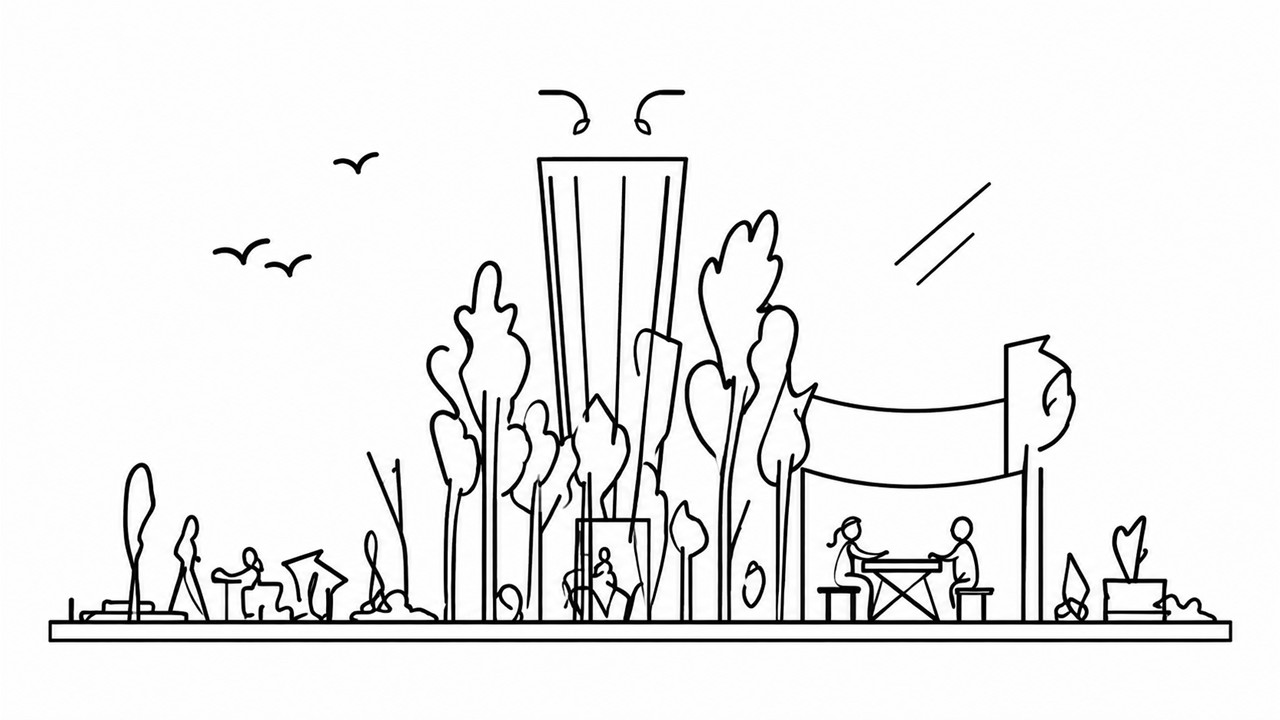
It works at every scale. Ecosystem regeneration can cool and green a courtyard, a care home, a public square, anywhere heat has made life hard. When coordinated at large scale, we can begin to shift the climate of a whole region and bring rain back to ground that lost it.
We start small and near, with proving open-source technologies that fix the water cycle. Our aim is to apply these technologies at large scale in degraded landscapes where billions of people depend on. We have published a blueprint for the regeneration of the Sinai, in Egypt, that presents the methodology for landscape-scale regeneration.
Near you
Cooling paired with new nature, wherever heat has made life hard.
A whole region
Scaled and connected, the method can shift the climate of a degraded landscape and bring rain back to ground that lost it.
The Weather Makers Foundation is the proving ground. We develop and demonstrate the methods that restore the water cycle. We work open-source and encourage others to join us.
Two paths
For funders & partners
Regeneration is a long endeavour and in our current economies, there is barely a business case. We rely on philanthropy to fund research and development of ecosystem regeneration methods.
Across Europe, it is becoming too hot to keep schools open. Care homes empty out in the afternoons. Festivals are cancelled, and there are days when whole neighbourhoods are simply unbearable to be in. Heat stress is no longer a future risk, it is closing public life down now. In addition, more frequent floodings underscore that our local water cycles have collapsed.
The time to act is now.
Mission
Restore the water cycle.
We strive to restore the natural water cycle through nature-based regeneration, developing open-source science & technologies.
Vision
A green Sinai.
Our vision is the regeneration of the Sinai Peninsula with a durable water cycle, teeming with life. A shining example of ecosystem regeneration that can be applied to degraded lands where billions live today in ever harsher conditions.
Start small, aim high — proof-of-method for the public good.
Our objective is to develop and demonstrate the nature-based methods that restore the water cycle. Within our broader regeneration strategy for the Sinai we identified a set of nature-based solutions. The Foundation focuses on proving the ones that carry the method forward. These build on one another, from the buildable-now to the landscape-scale.
01
Katabatic Tower near you
Cooling paired with new nature, built at human scale where heat has made public life hard.
Donate [HOLD]
02
Katabatic Tower Sinai
The same tower, taken to the landscape where the water cycle has broken down most completely.
Donate [HOLD]
03
Rain pilot Spain
Bringing back the rain along a Mediterranean coast — the geography Millán Millán’s chain describes.
Donate [HOLD]
04
BSI
The Bardawil & Sinai Initiative: the method at the scale that convinces.
Donate [HOLD]
To confirm — the objective descriptions above are drafted from the project titles in the content document; per-project donation destinations are on hold.
It began with a question almost no one thought to ask.
In 2016, a team of dredging engineers was asked to look at a dying lagoon on the edge of the Sinai: Lake Bardawil, silting up and losing its life. The obvious job was to dredge it. But one question kept pulling at them: what if you didn’t just clean the lagoon, but used what you took out of it to bring the whole landscape back?
The insight
From moving sediment to moving weather.
The people who started this work were not climate campaigners. They were engineers who understood, in detail, how to move water and earth at enormous scale. What changed everything was meeting the science of the water cycle — and the people who had spent their lives studying it.
John D. Liu, Millán Millán and Ties van der Hoeven.
From the late Millán Millán, the Spanish meteorologist who traced how the loss of vegetation along Mediterranean coasts breaks the chain that brings summer rain, came the mechanism: vegetation, evaporation, and rainfall are linked in a loop, and the same loop that had turned the Sinai to desert over thousands of years could, in principle, be run in reverse. From John D. Liu, who documented the regreening of China’s vast Loess Plateau, came the proof that degraded land can be brought back to life on an enormous scale. And from John Todd, a pioneer of ecological design, came a way of thinking that runs through everything we do: that living systems, well arranged, can do the work themselves.
It was an audacious thought: that humans, who had unmade these landscapes, could deliberately remake them. Not by fighting nature, but by giving it back the conditions it needs to do the work itself.
The people
The thinkers who shaped the initiative
Ties van der Hoeven
Who connected all the dots and concluded that human’s industrial capacity, in case moved into the right direction, can rapidly restore lands, weather and climate.
John D. Liu
Who documented the regreening of China’s vast Loess Plateau: proof that degraded land can be brought back to life on an enormous scale.
Millán Millán
The late Spanish meteorologist who traced how the loss of coastal vegetation breaks the chain that brings summer rain: the mechanism at the heart of our work.
John Todd
A pioneer of ecological design, whose thinking runs through everything we do: living systems, well arranged, can do the work themselves.
Standing on real science
An idea is only as good as its evidence.
The team sought out the scientists who could test the thinking and built the idea on established work in atmospheric moisture, land-atmosphere feedbacks, and ecological restoration. Over the years that followed, the approach was developed with researchers at leading universities and institutes, and deepened through doctoral research into how landscapes recycle their own water and how degraded drylands can be brought back.
The result is not a single invention. It is a method assembled from hydrology, ecology, and engineering for restoring the water cycle, set down in an open-source blueprint so others can build on it.
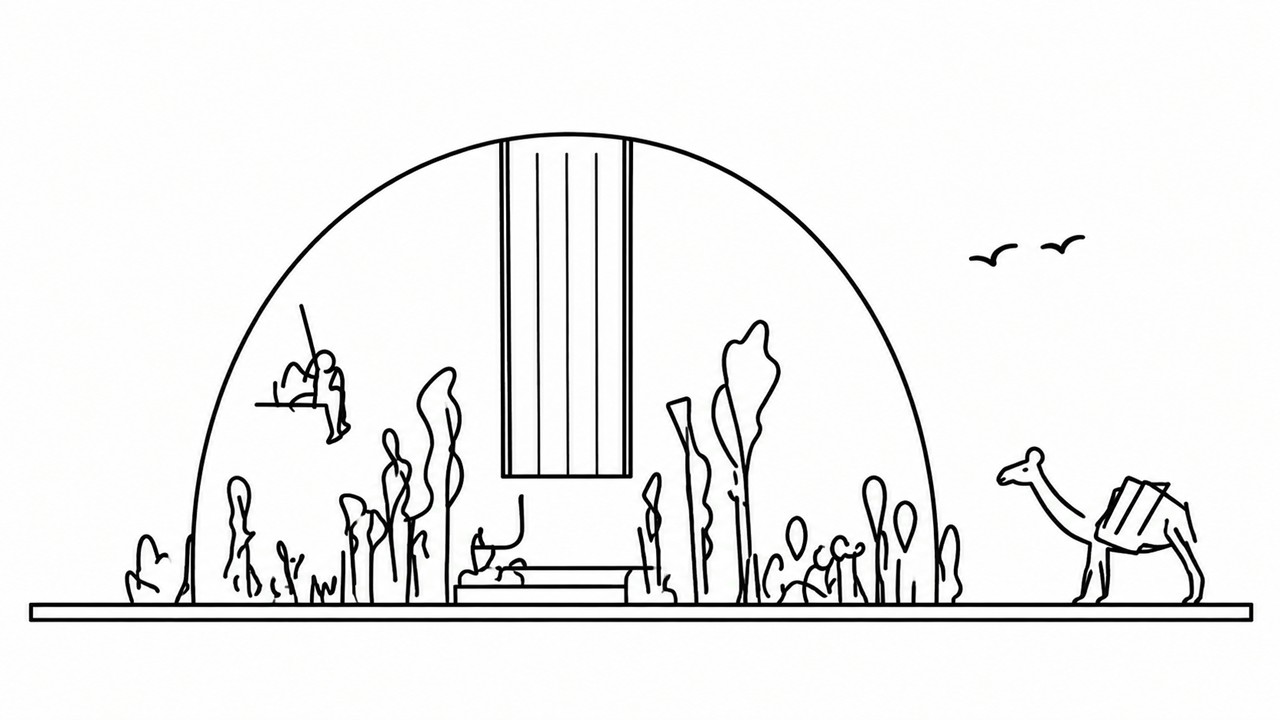
Our research dome, where parts of the method are tested by hand.
Explore · The Initiative
The Bardawil & Sinai Initiative.
The Sinai was once green. Vegetation held the soil, moisture moved through the landscape, and rain fell on land that now lies bare. Over thousands of years the vegetation was lost, the surface overheated, and the water cycle broke down, until green land became desert. It presents the perfect challenge: if the water cycle can be restored here, it can be restored anywhere. The Sinai is where the method is taken to the scale that matters.
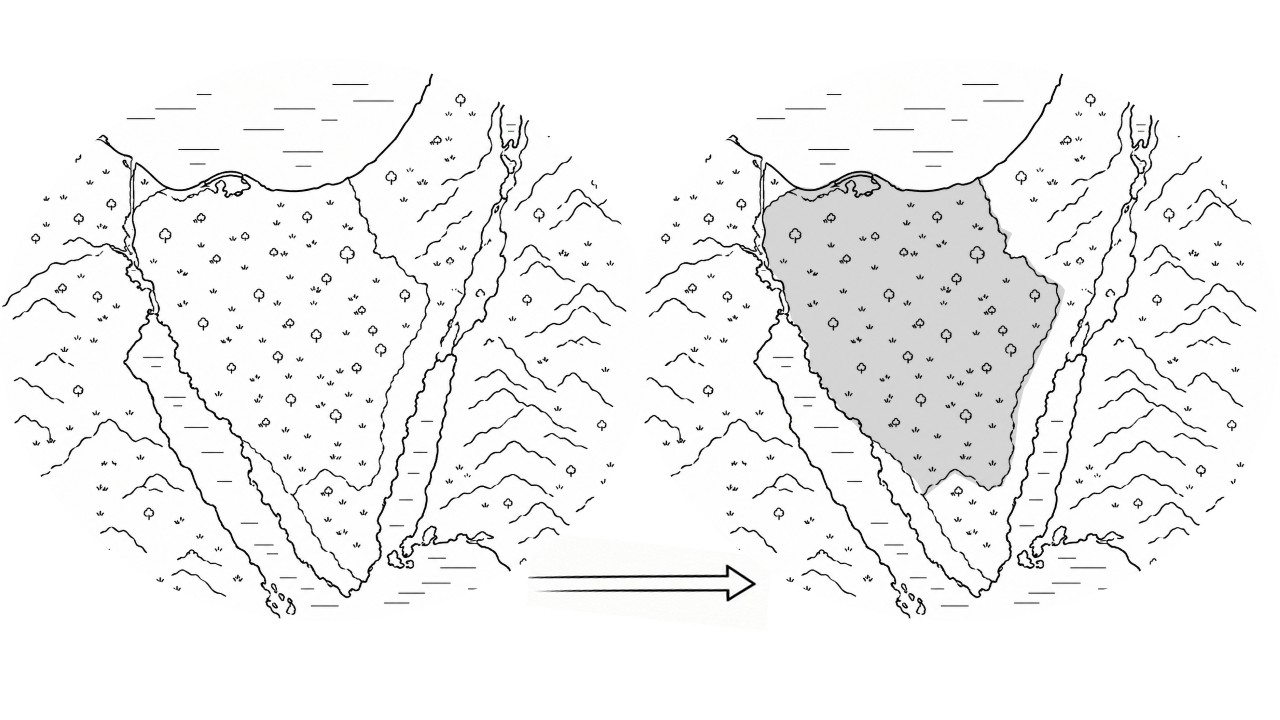
The Sinai today A near-complete breakdown of the local water cycle.
The Sinai regenerated The same peninsula with its water cycle restored.
Why this landscape
The technical rationale.
01
Degradation at its most extreme
The Sinai represents a near-complete breakdown of the local water cycle, making it both a demanding test of the method and the clearest possible demonstration of recovery.
02
Sea, sediment, and coast in one place
Bound by the Mediterranean and shaped by Lake Bardawil, the peninsula provides the resource that degraded drylands still have in abundance: seawater and marine sediment, together with a coastline to work from and high mountains to work with.
03
A measurable system
As a defined coastal-lagoon-and-peninsula system, the Sinai allows the mechanisms of restoration — evaporation, cooling, salinity, sediment, vegetation, moisture recycling — to be modelled and measured within one watershed.
The physical starting point: Lake Bardawil
It begins with the lagoon.
Lake Bardawil is a large, shallow coastal lagoon on the Sinai’s Mediterranean shore. Once considerably deeper, it has silted up to a few metres, its inlets to the sea have narrowed, and its waters have grown hypersaline. Conditions that suppress its ecology. Restoring the lagoon’s exchange with the sea is the first physical intervention of the initiative.
Deepening and stabilising the inlets substantially increases the tidal prism, which is the volume of seawater exchanged with each tide. Modelling of this intervention indicates a large rise in tidal exchange, a corresponding fall in salinity across much of the lagoon, and a multiplication of the lake’s biological productivity over a decade. The lagoon becomes the initiative’s first working component: a measurable ecological and economic recovery from a single, well-defined intervention.
The lagoon and the coast it exchanges with.
The method, at landscape scale
From a lagoon to a living region.
The principle proven at human scale (cooling paired with new nature) is the same principle that regenerates a landscape. In the Sinai it unfolds across connected, technical stages:
Move water inland
A managed waterway carries seawater and its sediments from the coast into the interior, with salt-tolerant vegetation established along its course.
Build soil from local resources
Marine sediment becoming available from the lagoon regeneration dredging works are usually a disposal problem in conventional dredging. Now these sediments are converted through staged bioremediation into fertile, living soil, and the seedlings to plant it, without importing scarce topsoil or freshwater.
Cool the land and strengthen the breeze
Evaporative cooling towers move water into the air, lowering surface temperature and reinforcing the moist sea breeze that carries the conditions for rainfall inland.
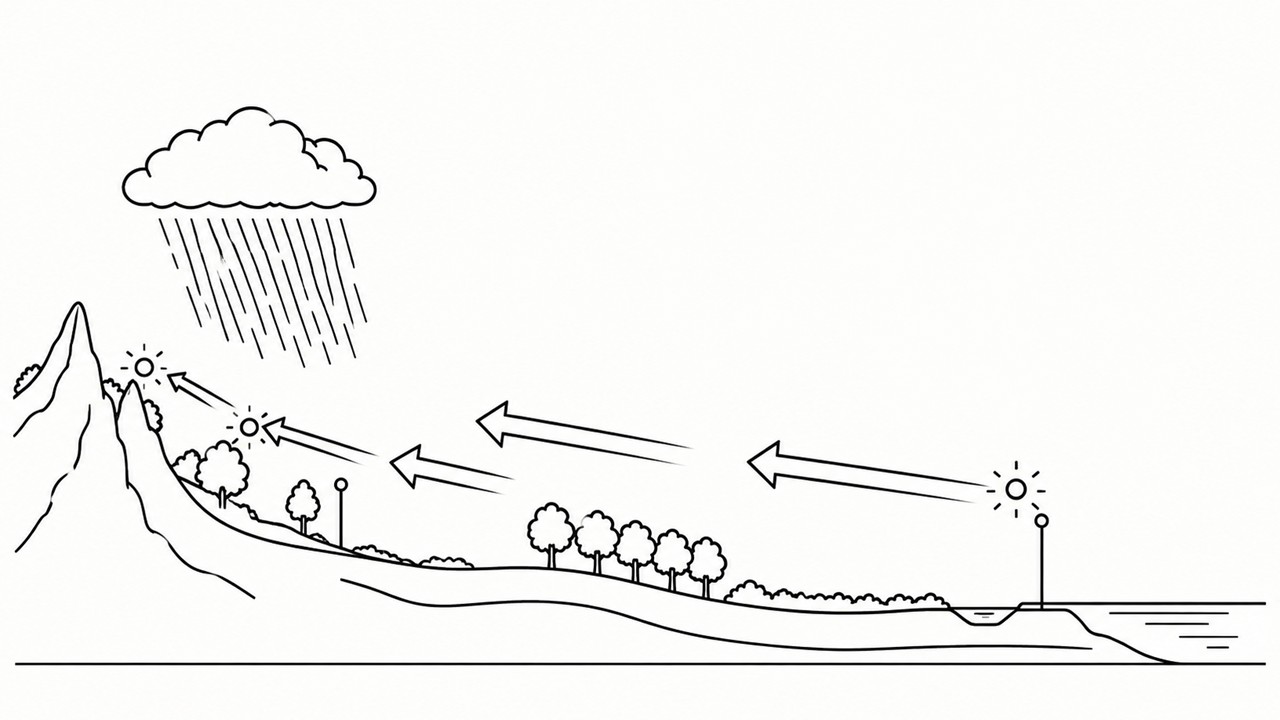
Today: the breeze arrives, but the land has too little moisture to trigger rain.
Restored: vegetation loads the air, and the rain returns.
Together these stages restart the cycle: cooler, vegetated land that recycles its own moisture and brings back rain.
Grounded, not speculative
Built with leading science. Developed together with researchers at Wageningen University, TU Delft, Utrecht University, and Wetsus.
Proven in our own trials. Beyond the published science, we have validated key parts of the method ourselves through hands-on experiments in our research dome, where we tested the desalination of marine sediments, the role of evaporation in cooling and moving water, and bioremediation; using living systems to build soil, clean water, and bring back biodiversity.
Two completed PhD theses underpin the core models: how landscapes recycle their own water, and which vegetation restores them.
Closing
Proof at the scale that convinces.
The Sinai is the destination, not the starting line. The same method that cools and greens a space near you is the method that, scaled and connected, can regenerate a degraded region. The Initiative is where the evidence is meant to converge.
Our work rests on a body of atmospheric and ecological science with a clear, testable claim: that the loss of vegetation doesn’t just follow a drying climate, it helps cause it, by breaking the local water cycle. And what human land-use broke, deliberate restoration can begin to repair.
The mechanism
How a coast makes its own rain.
In a Mediterranean-type climate, summer rain depends on a chain of events. The sea holds a standing reserve of moisture in the air above it. During the day the land warms in the sun and draws in a sea breeze, carrying that moist air inland. As the air passes over vegetated land, plants release water through evapotranspiration; adding moisture and cooling the air at the same time. Where mountains rise close to the coast, this moist air is pushed upward, cooling until it condenses into cloud and falls as rain. The rain feeds the vegetation, which feeds the next day’s evapotranspiration. Water begets water.
This is a loop, and its weakest link is the vegetation.
The loop intact — sea breeze, evapotranspiration, uplift, rain.
The loop broken — the air rises drier, and the rain no longer forms.
How the loop breaks
When the land stops transpiring.
Remove the vegetation (through deforestation, draining wetlands, or large-scale land conversion) and one link fails. The sea breeze still blows and the land still heats, but there is too little evapotranspiration to load the air with the moisture it needs. The air rises drier, condensation no longer reliably occurs, and the summer rains become irregular and then rare.
The consequences compound. With less local rain, groundwater drops, soils dry and erode, and the land’s capacity to transpire falls further. A downward spiral. And the moisture that no longer falls locally doesn’t disappear: it can travel and contribute to extreme rainfall elsewhere. Broken in one place, the water cycle drives both drought here and flooding there.
The reversal
The solution is, in theory, utterly simple.
If lost transpiration breaks the cycle, restored transpiration can begin to mend it. Bring vegetation back to the right places through erosion control, soil restoration, and replanting, and evapotranspiration rises again, returning the trigger moisture to the air, supporting cloud formation, and reviving the rains. Intact ecosystems sustain the loop; the loop sustains the ecosystems.
There is, however, an honest limit. The science suggests the cycle can be restored as long as the soil itself has not been lost. Where degradation has passed into massive erosion, recovery becomes far harder. This is precisely why acting deliberately matters, and why proof and careful site selection are central to everything we do.
Simple in theory. The hard part is doing it at scale, in the right places, with the evidence to prove it works, which is the Foundation’s whole reason for being.
The late Millán M. Millán (1941–2024), former director of the Mediterranean Centre for Environmental Studies (CEAM) and a climate advisor to the European Union, spent decades reanalysing field data from across the Western Mediterranean. He showed that summer rainfall there depends on a chain that is easy to break: a sea breeze carries moist air inland and up the mountain slopes, but that sea moisture alone is not enough to make rain. It needs a second ingredient, the trigger: extra moisture released by vegetation through evapotranspiration as the air crosses the land. Remove the vegetation, and the trigger is lost. The air keeps rising and heating, condensation no longer occurs, and the summer storms fade.
Reference: Millán, M. M. (2014), “Extreme hydrometeorological events and climate change predictions in Europe,” Journal of Hydrology, 518, 206–224. doi:10.1016/j.jhydrol.2013.12.041
Drought here, floods there
Millán also showed where the missing rain goes. Moisture that fails to fall over the coastal mountains accumulates in layers over the sea and can be carried off days later to fall as extreme rainfall and flooding elsewhere in Europe. A broken local water cycle doesn’t just dry one region, it destabilises rainfall far beyond it.
Local moisture recycling
More recent doctoral research quantifies how much evaporated water returns as rain over the same land, and finds it highest in coastal and mountainous areas. Exactly the geography of Mediterranean climates, and the basis for choosing where to act.
Reference: Theeuwen, J. J. E. (2025), Regreening for Natural Water Production, Utrecht University.
Desert-vegetation baseline
Further doctoral research establishes which vegetation belongs in these dryland systems, the ecological groundwork for restoration that fits the land.
To confirm — the document links above are placeholders until the files or landing pages are published.
Closing
From mechanism to method.
Understanding why the rain left is what makes bringing it back possible. Every objective we pursue is an application of this one mechanism: restore the vegetation and the evaporation, and the water follows.
Trust · Who We Are
The people who carry the work.
A foundation is its people: the ambassadors whose lifetimes of thinking shaped the method, the board that holds it to account, and the many who gave their knowledge and energy along the way.
Ambassadors
Four voices who lend the work their weight.
Millán M. Millán (in memoriam)
1941–2024 · Former director of the Mediterranean Environmental Studies Centre (CEAM) and advisor on climate change for the European Union
“Water begets water, soil is the womb and vegetation is the midwife.”
John D. Liu
Film maker and ecologist
“Now is the time to use our influence and knowledge to drive positive change. By restoring water cycles and the biosphere, we can enhance food security, biodiversity, and societal well-being.”
John Todd
Pioneer in ecological engineering · Founder of The New Alchemy Institute · RSENR research professor
“There’s just so many positive directions that are possible and economically feasible. If we could get the larger public really excited about how nature can be made to clean up, then people would say, ‘we can do it. We’ve got a future.’”
From an interview with Steve Rose, The Guardian. Photograph by Simon Simard.
Tom Middendorp
Chairman of the International Military Council on Climate and Security
“Our changing climate also comes with huge potential security impacts as the increasing droughts and floods affect the food- and water security of complete regions in the world. This has a disrupting effect on societies, especially in fragile regions, resulting in internal friction, migration flows and new breeding grounds for extremism. New concepts are needed to turn that tide.
The Bardawil & Sinai Initiative offers a groundbreaking comprehensive initiative for ecosystem restoration by restoring the water cycle in the region. A regreened Sinai can help restore the relationship between society and nature and counter the disruptive security effects of our changing climate.”
The Board
Who holds the Foundation to account.
Bunno Arends
Board member
Bio to confirm.
Gijs Bosman
Board member
Bio to confirm.
To confirm — board bios, roles, and which portrait belongs to which member. A US Executive Director is still to be named.
With thanks
The work of many hands.
Since 2016, the Bardawil & Sinai Initiative has grown from a question almost no one thought to ask into a living body of evidence. That journey has been the work of many hands, engineers, ecologists, scientists, advisors, and friends, each giving their knowledge, energy, and belief to it. To everyone who has contributed along the way: thank you for your part in it (in alphabetic order):
Maddie Akkermans · Jesús Areso · Thibaut Arnould · Philip Bangen · Gabi Belido · Rick van Bentem · Clement Bijl · Malik Boukebbous · Camille Daligaux · Maaike Dijkmans · Chris Diters · Wout van Doorn · Ingmar Drost · Pierre de Geest · Maria Georgiou · Anneleen Geurts · Delphine van Goethem · Dalma Haasz · Daniel Halsey · Bert Hamelers · Jonas Harding · Mohamed Zakaria Hatim · Robin Heukels · Wouter Hoek · Joffrey Hoijer · Pieter van Hout · Sander Hulst · Angel Imaz · Rhamis Kent · Dennis Kerkhoven · François de Keuleneer · Weruschca Kirkegaard · Juliette Kool · Tobias van Kooten · Merel Kroeders · Rogier Kuipers · Maarten Lanters · John D. Liu · Bob Maaskant · Millán Millán · Arjan Mol · Sanne Murraij · Mohammed Nawlo · Pepijn Noordhuizen · Loukianos Panagopoulos · Josien Rompelberg · Maged El Said · Edward Schram · Farah Shishani · Josien Steenberg · Marcel Stive · Charling Tao · Jolanda Theeuwen · John Todd · Nancy Todd · Eduardo Vias Torres · Duke ten Velden · Sarah Warnau
Trust · Partners
We don’t do this alone.
Restoring a water cycle draws on many fields, such as hydrology, ecology, geomorphology and atmospheric science, to name only a few. More than any one organisation holds. The Weather Makers Foundation works with research institutions and specialists to test ideas and develop know-how open-source.
Science & knowledge partners
Where the method is tested.
WetsusEuropean centre of excellence for sustainable water technology.
Delft University of TechnologyWater, coastal, and hydraulic engineering.
Wageningen University & ResearchEcology and land-system science.
Utrecht UniversityAtmospheric moisture and the water cycle.
HCSSThe Hague Centre for Strategic Studies — eco-security.
These are working collaborations. Listing a partner here indicates that we work together; it is not a claim of endorsement.
Can you test the method, or take it further?
We build through collaboration, across ecology, engineering, and policy. If your work touches the water cycle, we would like to hear from you.
The Weather Makers exist as two complementary bodies. This page sets out which is which, why the split exists, and where to find the documents that prove it.
Non-profit
The Weather Makers Foundation
A Dutch non-profit. Its role is to prove and promote ecosystem regeneration methods on an open-source basis. It is funded by philanthropy and grants. This website is of the Foundation.
Company
The Weather Makers BV
A company that provides engineering advice in Nature-based Solutions.
Why two?
Because the returns don’t yet add up on their own.
Today, regenerating nature has barely any business case, and often none at all. The real value of a living landscape, the water it stores, the air it cools, the life it carries, is almost absent from our economy. Carbon credits go a small way on the voluntary market, but a decade of experience taught us the same lesson again and again: the returns don’t yet add up on their own, and so the projects that matter most never get built.
This is exactly why a foundation is needed, and what it is for. By proving what works, openly and rigorously, the Foundation builds the evidence that lays the path toward a real business case: showing where regeneration pays, what it is worth, and how it can one day stand on its own. For anyone to use!
Recognised non-profit status
Registered where it counts.
Netherlands
ANBI
The Weather Makers Foundation is a registered ANBI (Algemeen Nut Beogende Instelling), the Dutch status for public-benefit organisations. Dutch and EU donors may receive tax benefits on their gifts.
To confirm — publish ANBI-required details: legal name, RSIN, KvK number, contact, and current financial figures.
United States
Equivalency Determination
For US foundations and donor-advised funds, the Weather Makers Foundation holds an Equivalency Determination — a formal assessment that we are the equivalent of a US public charity under IRS rules. This allows US grantmakers to fund our work as they would a domestic public charity.
Note: an ED supports grants from US foundations and DAFs; it is not the same as personal tax-deductibility for individual US donors.
To confirm — ED status, the repository/practitioner holding it, and its validity date before publishing.
To confirm — document links are placeholders until the files are published.
Act · Support the Work
Fund the proof.
Restoring the water cycle is a long endeavour. It begins with evidence, and evidence is what your support pays for. Not overheads, but concrete pilots getting built, monitored, evaluated and published publicly. This is how you help to move the blueprint one proven step closer to scale.
What your support does
Four things, concretely.
Builds and monitors pilots — cooling paired with new nature, demonstrated and monitored on site.
Advances the science — the modelling and field research that turn a promising idea into a proven method.
Keeps the knowledge open — published results anyone can build on.
Moves the blueprint forward — enabling more and more steps of the blueprint to be taken.
What the proof looks like at human scale: cooling paired with new nature.
Ways to give
However you fund, we can receive it.
For philanthropic funders & foundations
We work with funders on multi-year support for specific objectives. Because we hold an ANBI status (NL) and a US Equivalency Determination, both European and US grantmakers can fund the Foundation directly.
Whether you’re a researcher who can test the method, an institution that wants to collaborate, a funder exploring support, or a journalist looking into the work, this is the way in.
Send a message
One form, routed by reason.
To confirm — this form composes an email in your own mail client. Wiring it to a server-side handler (or a form service) is a step for the live build.
How we collaborate
Four ways in.
01
Science & research
Modelling, field measurement, peer testing of the method.
02
Engineering & implementation
Bringing pilots to real sites.
03
Funding & philanthropy
Multi-year support for the proof.
04
Press & speaking
To confirm — press contact and press kit.
Act · FAQ
Frequently asked questions.
The questions we are asked most — about the Sinai, about the evidence, and about why a foundation had to exist at all.
Why Sinai?
In 2016, a team of dredging engineers was asked to look at a dying lagoon on the edge of the Sinai: Lake Bardawil, silting up and losing its life. The obvious job was to dredge it. But one question kept pulling at them: what if you didn’t just clean the lagoon, but used what you took out of it to bring the whole landscape back?
Since then the idea to regenerate this vast desert into a thriving landscape has not lost our sight. It is bold, iconic and doable. Though we realise that transforming a landmass this size from your desktop in Europe is only possible after you have proven at human scale that this can be done.
We already collaborate closely with local communities in Egypt and will scale up when the chances are there.
Are there other degraded lands where this technology can be applied?
Yes. The mechanism is not specific to the Sinai — it applies wherever a coastal water cycle has been broken and the soil has not been lost. Three landscapes we are asked about most:
Morocco
To confirm — description.
Oman
To confirm — description.
Spain
To confirm — description. See also our pilot proposal, “Bring back the Rain in Spain”.
Is there a link between human population and bio-degradation?
Sure. There is a sinister pattern that wherever humankind has thrived for a long period of time, lands have been degraded. Lands extensively habituated have degraded and eventually mostly been abandoned. Some examples:
The Fertile Crescent and Mesopotamia
Parts of southern Mesopotamia (modern Iraq) were among the world’s most densely populated regions 4,000–5,000 years ago. Over centuries, intensive irrigation caused increasing soil salinization. Crop yields declined, agricultural productivity dropped, and some regions were gradually abandoned or lost population. Environmental degradation did not destroy Mesopotamian civilization, but it shifted settlement patterns and reduced the ability of certain areas to sustain large populations.
The Classic Maya Lowlands (c. 750–900 CE)
The southern Maya lowlands of present-day Guatemala, Belize, and southern Mexico supported dozens of large cities and millions of people. During the so-called Classic Maya Collapse, many major urban centers were abandoned and populations fell dramatically. Archaeological and climate evidence points to a combination of severe droughts, deforestation, soil degradation, and political instability. Modern research increasingly views environmental stress as a “threat multiplier” that undermined already complex societies.
Why are you so sure that it works?
We have seen examples of ecosystem recovery on every continent. A good example is the regeneration of the Loess Plateau in China in the late 1990s. It successfully transformed roughly 4 million hectares of severely degraded, erosion-prone land into thriving forests and grasslands.
In Mozambique, the Gorongosa National Park saw a near collapse during the civil war, but has seen a dramatic recovery since after the area was stripped of wires and booby traps, hunting was restricted and key animals were reintroduced.
An example in popular culture is the documentary “The Biggest Little Farm”, portraying the transformation of a barren land into a thriving, bio-diverse regenerative farm in California, USA.
Why a Foundation?
For over 10 years we have tried to make a business out of greening the earth, but to no avail. There is hardly a business case in ecosystem regeneration. Fortunately there always have been people around us willing to support us with in-kind know-how & advice and with funds. In order to keep both our dream of a green Sinai and the business alive we have split our activities into a business (for profit) and a Foundation (based on philanthropy).
The Weather Makers BV — the company that provides engineering advice in Nature-based Solutions.
The Weather Makers Foundation — created to do something markets do not: fund science, and develop open-source methods to re-green landscapes.
Mankind can not live on an empty planet. We need to reverse the trend of ecosystem degradation and showcase that a green world is possible. You can be part of the solution. Your funds will help to provide the know-how and technologies for anyone in the world to use to reverse the biodiversity loss and develop thriving landscapes instead.